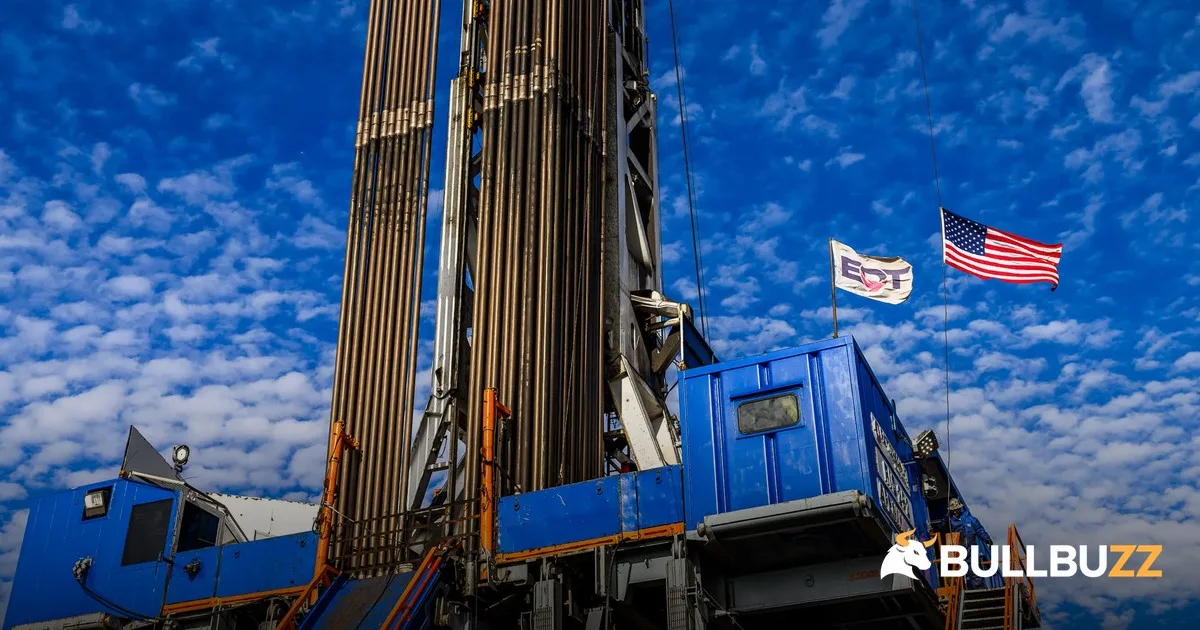
The EQT-Range merger would combine two Appalachian natural-gas producers through an all-stock transaction announced on 26 October 2026 MYT. EQT plans to acquire Range Resources, with the companies putting the combined business's enterprise value above US$50 billion.
The companies' joint announcement sets an exchange ratio of 0.987 EQT shares for each Range share. Both boards have approved the agreement, while completion remains conditional on shareholder votes, regulatory clearances and other closing requirements.
The transaction adds a company-specific development to a volatile energy backdrop. BullBuzz recently covered Brent's Gulf supply risks. This agreement concerns ownership and operations in American natural gas, with its own timetable and approval process.
EQT-Range Merger Uses Shares Instead of Cash
Independent reporting carried by Yahoo Finance confirms the all-stock structure and the combined enterprise-value figure. That measure describes the resulting business; it should not be read as a US$50 billion cash payment to Range shareholders.
The exchange ratio is the immediate number for holders to examine. As an illustration, 1,000 Range shares correspond to 987 EQT shares under the stated ratio, before any holder-specific treatment described in the final transaction documents.
The cash-market value of that consideration will move with EQT's share price. A fixed number of shares therefore leaves investors exposed to market fluctuations between announcement and completion. The ratio alone does not establish a guaranteed dollar return.
EQT's existing holders are expected to own roughly 73% of the combined company, with Range holders owning about 27%. The companies are targeting completion in the first quarter of 2027.
Scale and Savings Remain Forward-Looking Targets
The companies describe a combined production base exceeding 9 billion cubic feet equivalent per day, supported by more than 30 years of inventory and over 3,700 miles of midstream infrastructure. These are figures presented for the proposed combined operations.
Management expects US$325 million of annual base synergies within two years, covering corporate functions, operations and commodity marketing. Those savings are a target, rather than money already realised. Investors will need to assess the costs and practical work required to integrate the businesses.
Production capacity, transport connections and financial returns are separate measures. A larger resource base can broaden operational options, while the value of those options still depends on gas prices, spending requirements, access to customers and execution.
Approval and Integration Risks Need Separate Checks
Reuters reporting hosted by Euronext corroborates the acquisition announcement. The companies' release warns that approvals may be delayed, conditions may change the economics and anticipated benefits may take longer to achieve.
Board approval is one completed step. Shareholder and regulatory decisions remain part of the path to closing. Until the transaction completes, investors should distinguish the proposed combined business from the two companies' current standalone operations.
That distinction also applies when comparing corporate actions across sectors. BullBuzz's Abbott nutrition spin-off report concerns a different restructuring mechanism. A merger's exchange terms and approval conditions require their own assessment.
What Malaysian Energy Investors Should Watch
For Malaysian readers following international energy shares and gas markets, the announcement offers a new transaction to track. It does not establish an immediate change to Malaysian gas contracts, local supply or retail energy prices.
The next useful checks are the formal shareholder materials, the voting timetable and regulatory progress. Investors can compare the exchange ratio with prevailing share prices while keeping the risk of a delayed or unsuccessful deal in view.
Future disclosures should also show how integration spending and the savings timetable fit the combined company's finances. The first-quarter 2027 closing target remains conditional, and subsequent company filings will determine whether the transaction advances on that schedule.